Dishwasher Not Draining? 6 Safe Checks Before Calling | USA Homewise
Why Is My Dishwasher Not Draining? What to Check Before Calling a Repair Technician
Standing water does not automatically mean a failed drain pump. Start with safe, accessible checks to separate a clogged filter or shared drain problem from a fault that needs professional repair.
Why Is My Dishwasher Not Draining? What to Check Before Calling a Repair Technician
A dishwasher that is not draining may have a dirty filter, a blocked sink or garbage disposal connection, a restricted drain hose, or an internal pump problem. If the trouble started just after a garbage disposal replacement, the disposal’s dishwasher inlet knockout plug may still be in place.
First, confirm that the cycle finished and check whether the kitchen sink drains normally. If there are no leaks or electrical warning signs, try your model’s cancel/drain procedure once. Then disconnect power before inspecting the filter or other accessible parts.
You do not need to pull out the dishwasher, disconnect plumbing, or open electrical compartments for these initial checks.
Is Water in the Bottom of a Dishwasher Normal?
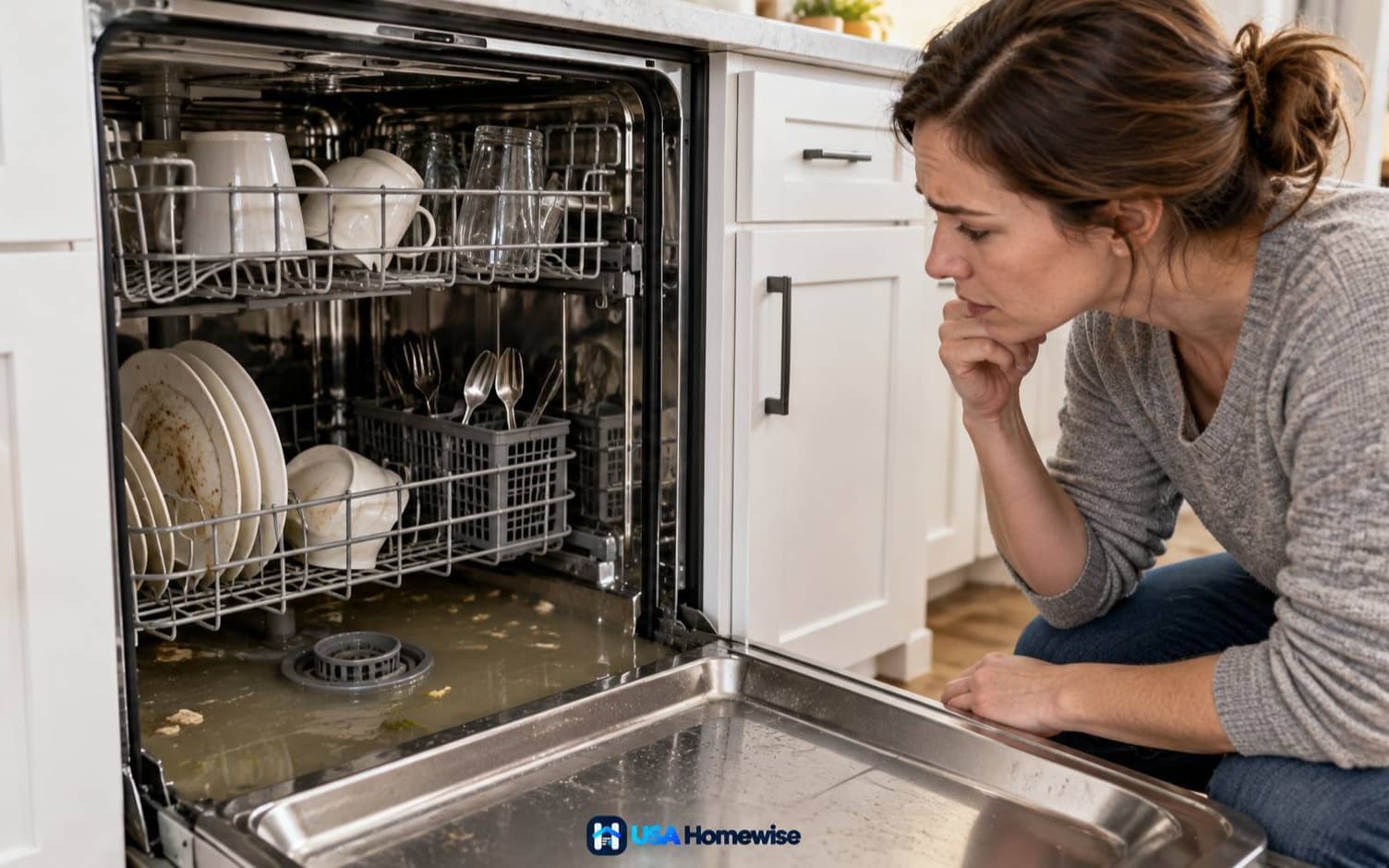
A small amount of water confined to the recessed sump or filter area can be normal on some models. A broad pool covering the tub floor, water approaching the door opening, or water remaining after a completed drain operation warrants investigation.
There is no universal normal water depth. Consult your model’s owner’s manual rather than assuming every visible drop means something is wrong.
The timing also provides useful clues:
After an interrupted cycle: The dishwasher may not have reached its drain step.
After a completed cycle: A blockage or drainage-system fault is possible.
After successful draining, especially when the sink runs: Wastewater may be returning through the drain connection.
While the appliance is off, without sink use: A water-inlet valve or backflow problem may require professional diagnosis.
These observations help narrow the cause; they do not identify a failed part on their own.
Safety Precautions Before Troubleshooting
If water is leaking onto the floor, stop using the dishwasher. Shut off its dedicated water supply if you can reach the valve safely. If water is near outlets, wiring, or electrical equipment, do not touch those components or step into the water. Get qualified help.
Before removing standing water or inspecting parts:
Let hot water and interior components cool.
Switch off the dishwasher’s circuit breaker, or unplug it if the plug is accessible in a dry location. The control-panel power button is not an electrical disconnect.
Wet laundry does not automatically mean a failed washer motor. Start with cycle settings, load balance, and drainage, then learn which symptoms call for professional repair.
Scoop out pooled water with a cup, then use a sponge for the remainder.
Watch for broken glass. Wear cut-resistant gloves, but never reach blindly into the sump or pump opening.
Do not remove service panels, disconnect wiring, or pull out a hardwired dishwasher as part of basic troubleshooting. Keep power disconnected during hands-on checks, and never operate the appliance without its filter and required covers installed.
Quick Guide to Dishwasher Drainage Problems
What you notice
Possible cause
Best first step
Water remains after an interrupted cycle
The drain step has not finished
Follow the model’s cancel/drain instructions
Both the dishwasher and sink drain slowly
A restriction in shared drain plumbing
Address the sink blockage before another wash
Trouble began after disposal replacement
An unopened dishwasher inlet or disturbed hose
Contact the installer
Food debris surrounds the filter
A restricted filter or sump entrance
Clean the user-removable filter
Water spills from the countertop air gap
A restriction in the fitting or downstream hose
Inspect the accessible air-gap parts
The dishwasher hums but does not drain
A blockage or pump fault
Stop repeated attempts and complete safe checks
Water returns after draining
Backflow, incorrect hose routing, or a valve issue
Note whether it happens when the sink runs
6 Things to Check Before Calling a Repair Technician
1. Confirm the cycle ended and try cancel/drain once
An opened door, power interruption, or canceled program can leave a cycle incomplete. Check the display and consult the owner’s manual for the correct cancel/drain procedure. Button sequences differ by model; a generic reset sequence may not drain the tub.
Only attempt this with the dishwasher fully assembled and no leaks or electrical warning signs. If power is already disconnected, restore it only when safe to do so.
If the dishwasher drains, monitor whether the problem returns during normal use. If it does not drain, stop and disconnect power before proceeding. Repeatedly restarting a wash can add water or keep a struggling pump running without resolving the cause.
2. Check the kitchen sink and garbage disposal
Many dishwashers discharge into the kitchen sink’s drain piping or garbage disposal. A restriction in that shared path can prevent the dishwasher from emptying even when its pump works.
If the sink is already backed up, do not add more water or run another dishwasher cycle. A slow or blocked shared drain is generally a plumbing problem.
If the sink drains freely and the disposal operates normally, run the disposal with cold water according to its manufacturer’s directions to clear ordinary food residue. Do not run a jammed disposal or put your hand inside it. The disposal has its own power supply; disconnect that power before any disposal inspection or service.
If the disposal was recently replaced: Ask the installer to verify that the dishwasher inlet knockout was removed and the hose was correctly connected. Correcting an unopened inlet requires safe power isolation and proper hose removal and reconnection. Do not attempt to knock out the plug through an attached hose.
3. Clean the user-serviceable dishwasher filter
With dishwasher power disconnected and pooled water removed, take out the lower rack and locate the filter using the manual.
Some filters twist out by hand; others are not designed for routine homeowner removal. Do not force a filter or remove screws unless the manual explicitly describes that user-maintenance procedure.
For a removable filter:
Lift it out carefully without dropping debris into the opening.
Rinse it under running water.
Use a soft brush if the manufacturer permits it.
Remove loose, clearly visible debris from the surrounding accessible area without reaching into hidden passages.
Reinstall and lock the filter as directed.
Do not probe the pump with wire or tools. Leave debris beneath non-user-serviceable covers to an appliance technician.
4. Inspect the air gap, if installed
A dishwasher air gap is a small plumbing fitting commonly mounted beside the kitchen faucet. It provides a physical separation that helps prevent drain wastewater from siphoning into the dishwasher.
Not every installation uses one. Requirements depend on local plumbing rules and the dishwasher’s installation instructions.
Water spilling from the air gap during draining often indicates a restriction in the fitting or the hose leading from it to the disposal or sink drain.
With dishwasher power disconnected, remove only the accessible cap and cover as the air-gap manufacturer directs. Clear visible debris and reassemble the fitting. Do not push debris farther down the line or bypass the air gap. Call a plumber if the blockage is deeper or the overflow continues.
5. Look at the accessible drain hose
Inspect the visible hose under the sink without disconnecting it. Look for:
Sharp kinks or crushed sections.
Stored items pressing against the hose.
Cracks, loose connections, or signs of leakage.
Routing that differs from the appliance’s installation instructions.
Remove stored objects that are pressing on the hose, but do not tug on it or disturb its connections. A hose can also be blocked internally even if its exterior looks normal. Do not pull out the dishwasher just to inspect the hidden section.
Some installations use a secured high loop under the countertop; others require an air gap. A high loop is not a substitute for an air gap where local rules require one. Have a qualified installer or plumber correct uncertain routing rather than relying on a universal hose height or arrangement.
6. Check for excessive suds
Hand dishwashing liquid is not suitable for an automatic dishwasher. The wrong detergent or an inappropriate amount can produce excessive foam and disrupt normal operation.
If the tub is full of suds, stop the cycle and follow the appliance manufacturer’s recovery instructions. Do not keep restarting the machine or add household chemicals to suppress the foam. Correct the detergent issue before evaluating whether a separate drainage problem remains.
Test After Completing the Safe Checks
Before restoring power, reinstall the filter and all user-removable covers. Remove cups, sponges, and tools from the interior. Make sure accessible connections are dry and undisturbed.
Run the manufacturer’s drain procedure while watching for leaks at the door, air gap, and visible under-sink connections. If drainage succeeds, use a short rinse or other test cycle only as the manual allows to confirm normal operation.
Stop if water does not drain, leaks appear, or persistent unusual noises occur. Record any displayed error code before resetting the controls. If water returns later, note whether the sink or disposal was in use at the time.
What Not to Put in a Dishwasher Drain
Avoid shortcuts that can damage components or create a chemical hazard:
Chemical drain openers: Do not pour them into the dishwasher. If a drain opener has already been used in connected plumbing, tell the service professional before work begins.
Boiling water: Do not pour it into the tub or hoses to clear a blockage.
Mixed cleaning chemicals: Never combine bleach with vinegar, acids, ammonia, or other cleaners.
Baking soda and vinegar as a mechanical repair: They cannot correct a failed pump, an unopened disposal inlet, or a kinked hose.
Drain snakes or compressed air through dishwasher components: These can damage parts or dislodge connections.
A dishwasher cleaner is a maintenance product, not a substitute for diagnosing standing water. Use cleaning products only as the appliance manufacturer permits.
When to Call a Plumber or Appliance Repair Technician
Call a plumber for shared drain or connection problems
A plumber is usually the right choice when:
The kitchen sink is also backing up.
The air gap repeatedly overflows.
Accessible drain connections leak.
Drain-hose routing or shared plumbing needs correction.
If the trouble started immediately after dishwasher installation or disposal replacement, contact the installer first.
Call an appliance technician for persistent dishwasher faults
Arrange appliance service when the sink drains normally but the dishwasher still will not empty after the accessible checks. Internal pump, check-valve, sensor, wiring, and control problems need model-specific diagnosis.
A humming pump does not automatically need replacement, and a silent pump does not prove that its motor has failed. Avoid buying parts based only on sound or a single symptom.
Stop troubleshooting for burning smells, repeated breaker trips, damaged wiring, or water near electrical components. Leave the appliance off and seek qualified service; electrical-system problems may require a licensed electrician. For smoke or fire, leave the area and call 911 from a safe location.
Before calling for repair, gather:
The dishwasher’s model number.
Any error code.
When the water appears or returns.
Whether the sink drains normally.
Details of recent plumbing or installation work.
The checks you have already completed.
These details help the professional distinguish an appliance fault from a plumbing restriction without unnecessary guesswork.
Frequently asked questions
Can I run my dishwasher if there is standing water in the bottom?
Do not start another full wash when water is pooled across the tub floor. If there are no leaks or electrical warning signs, try the manufacturer’s cancel/drain procedure once with the dishwasher fully assembled. A small amount of water confined to the sump may be normal; consult your model’s manual.
Why did my dishwasher stop draining after a new garbage disposal was installed?
The disposal’s dishwasher inlet knockout may still be in place, or the drain hose may have been kinked or incorrectly connected. Ask the installer to verify the installation. Do not attempt to clear the inlet through the attached hose.
Does a humming dishwasher mean the drain pump is broken?
No. Humming may accompany a blockage or a pump fault, and sound alone cannot identify the cause. Stop repeated drain attempts, complete the safe accessible checks, and call an appliance technician if the problem persists.
Why does dirty water return after my dishwasher drains?
Water returning when the sink runs can indicate backflow through shared plumbing, incorrect hose routing, or an internal check-valve problem. A plumber can evaluate the drain arrangement; an appliance technician may be needed for an internal valve fault.
Will vinegar unclog a dishwasher that will not drain?
Vinegar is not a reliable repair for a dishwasher drainage failure. It cannot fix a kinked hose, unopened disposal inlet, or failed pump. Follow the manufacturer’s cleaning instructions, and never mix vinegar with bleach or other cleaners.
Incorrect settings, blocked vents, dirty coils, and leaking door seals can leave a refrigerator too warm. Protect your food first, then follow these safe troubleshooting steps to identify when professional repair is needed.