Washer Won’t Spin? Safe Checks Before Paying for Repair | USA Homewise
Washer Won’t Spin? What to Check Before You Pay for a Repair
Wet laundry does not automatically mean a failed washer motor. Start with cycle settings, load balance, and drainage, then learn which symptoms call for professional repair.
Washer Won’t Spin? What to Check Before You Pay for a Repair.
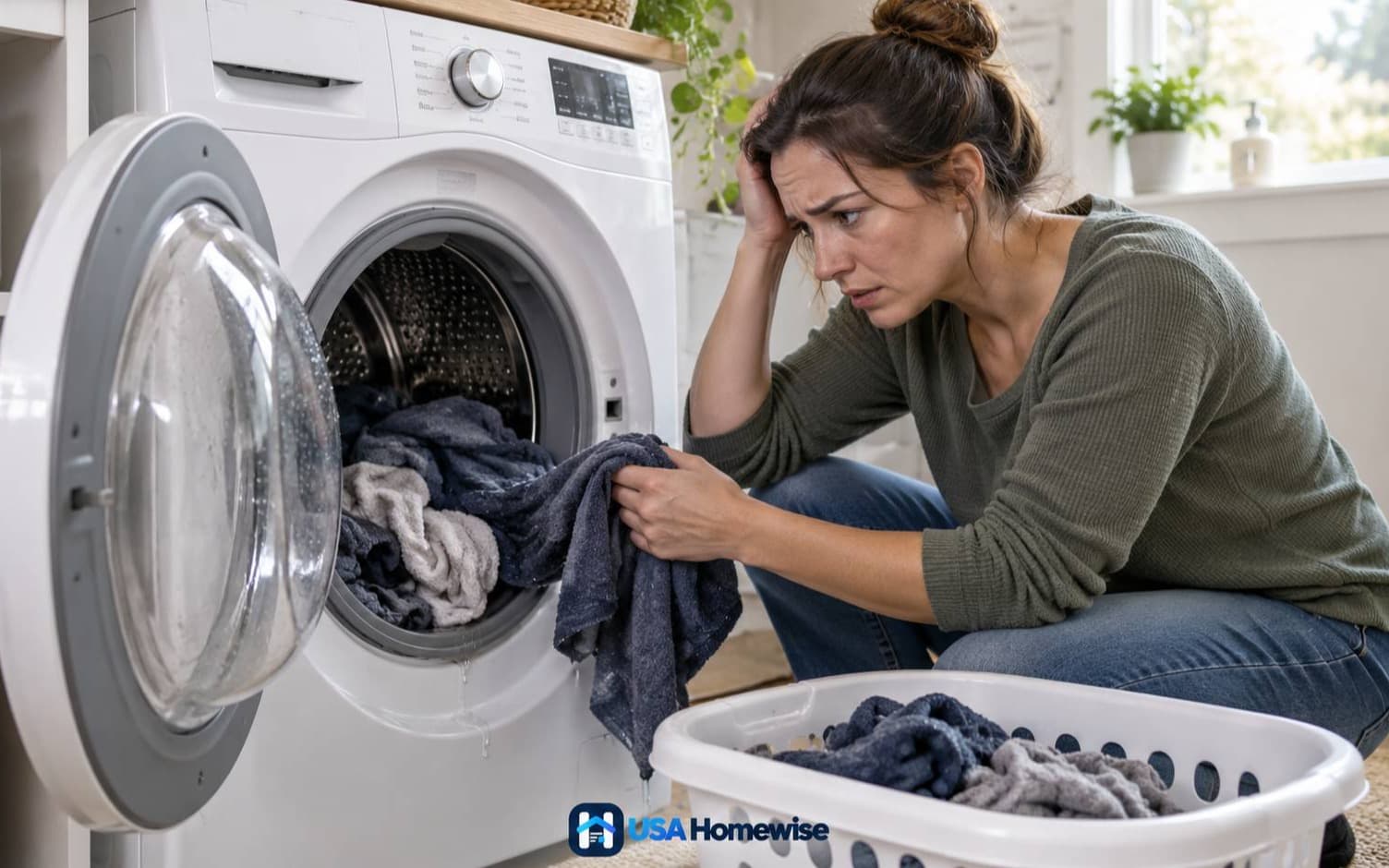
If your washer won’t spin, start with the simple causes: a low-spin or no-spin setting, an unbalanced load, standing water, excess suds, or a door or lid that will not lock. None of these automatically means the motor has failed.
First, check whether water remains in the drum. Standing water means you should troubleshoot drainage before attempting another spin. If the drum has drained but the clothes are unusually wet, start with the settings and load balance.
The checks below stay within homeowner-level troubleshooting. Use your washer’s exact model number to find its owner’s manual; drain-hose requirements, filter access, error codes, and reset procedures vary by model.
Before You Start: Know When to Stop
Do not run another cycle if you notice smoke, sparking, a burning smell, a tripped breaker, a significant leak, grinding, or severe shaking. Stop using the washer and arrange professional help. Outlet or circuit problems may require a licensed electrician rather than an appliance technician.
Follow these precautions throughout troubleshooting:
Pause or cancel the cycle and wait for all movement to stop before opening the lid or door. Never reach into a moving basket.
Unplug the washer before handling hoses, inspecting accessible components, or opening a manufacturer-designated maintenance filter.
If water is near the plug, outlet, or electrical components, do not step into it or reach across it to unplug the washer. Have power disconnected safely before addressing the leak.
Close the water supply valves if there is a leak or you need to disconnect a water supply connection, provided you can reach them safely.
Never force a locked door, bypass a lid switch, or insert anything into a lock opening.
Leave cabinet removal, electrical testing, internal repairs, and work beneath a heavy washer to a qualified appliance technician.
Match the Symptom to the First Check
Observe the washer only from outside the closed machine during normal operation. Do not restart it just to reproduce a dangerous symptom.
Standing water does not automatically mean a failed drain pump. Start with safe, accessible checks to separate a clogged filter or shared drain problem from a fault that needs professional repair.
Drain restriction, hose installation problem, or pump fault
Check accessible drainage items before retrying spin
Drum has drained, but clothes are very wet
Low-spin setting, imbalance, or unsuccessful spin
Review settings and redistribute the load
Washer repeatedly starts and stops spinning
Load-balancing attempts, excess suds, or a fault
Check the load and record any error code
Door or lid will not lock
Trapped fabric, obstruction, or lock-system fault
Inspect the closure with the washer unplugged
Washer bangs or moves
Unbalanced load, unstable footing, or suspension problem
Stop the machine; check loading and stability
Persistent humming without expected drum movement
Possible jam, pump problem, or drive fault
Stop repeated attempts and seek service if basic checks do not resolve it
Some washers pause or turn slowly while sensing and balancing a load. A brief pause alone does not establish a fault. Check the manual if the cycle stalls or never finishes.
1. Check the Cycle and Spin Settings
Before moving the machine or opening a filter, review the controls.
Delicate, hand-wash, and other specialty cycles may intentionally use a lower spin speed. A no-spin option leaves more water in the laundry, while a rinse-hold setting may retain water until you select a drain function.
Look for:
Low-spin or no-spin options.
A paused cycle or rinse-hold setting.
A delayed start or a cycle that has not reached the final spin.
An error message requiring a specific action.
If the washer has drained, there are no warning symptoms, and the fabrics permit machine spinning, select the appropriate Drain & Spin or Spin Only option described in the manual. Use a spin speed suitable for the items’ care labels.
Record any error code before trying a model-approved reset. Repeated resets do not fix a blockage or failed part and may clear information useful for diagnosis.
2. Redistribute or Reduce the Load
A washer may reduce or cancel high-speed spin when it detects an unbalanced load. A single blanket, bath mat, or small group of heavy towels can collect on one side of the basket.
Once the washer has stopped and unlocked:
Untangle clothing and distribute it more evenly.
Remove items if the drum is tightly packed.
Confirm that bulky items are allowed by both the washer manual and their care labels.
If the machine has drained and has no warning symptoms, make one appropriate spin attempt.
Do not automatically add more laundry. Additional items may help balance certain small loads, but they can also overload the machine. Follow the manufacturer’s loading guidance.
If ordinary, properly sized loads spin successfully but one bulky item does not, loading or item suitability is a useful lead—not proof that every mechanical component is working correctly.
Check the Washer’s Stability
With the machine off and unplugged, gently check whether it rocks at the corners. The feet should contact a firm supporting surface.
Follow the installation instructions for leveling and securing adjustable feet. Do not tilt the washer alone, reach beneath an unsupported machine, or use loose objects as makeshift supports.
If a front-loader has shaken severely since installation or a move, ask the installer to confirm that shipping hardware was removed as directed. Do not keep operating a washer that moves across the floor.
3. Check Drainage if Water Remains
Many washers will not enter full-speed spin until enough water has drained. A drainage problem can therefore look like a spin failure.
Inspect the Visible Drain Hose
Unplug the washer before handling the hose. Check accessible sections for kinks or crushing without pulling the machine into an unsafe position or straining its connections.
Compare the hose arrangement with the model’s installation instructions. Required drain height, insertion depth, and air-gap provisions vary; incorrect installation can interfere with draining or cause siphoning. Do not substitute a generic measurement for the manufacturer’s specifications.
Do not disconnect a water-filled hose without a controlled way to catch the discharge, and never pour chemical drain cleaner into the washer.
If the standpipe backs up or overflows during draining, stop using the washer and contact a plumber. The household drain may need attention rather than the appliance.
Clean the Pump Filter Only if the Manual Allows It
Not every washer has a homeowner-accessible drain-pump filter. Do not assume a panel or cap is intended for routine maintenance.
If the owner’s manual provides a cleaning procedure:
Unplug the machine and allow hot wash water to cool.
Protect the floor with towels and a shallow collection pan.
Use the emergency drain hose, if provided, exactly as instructed.
Drain gradually, emptying the container as necessary. A full washer can release more water than a small tray holds.
Remove accessible debris and clean the filter as directed. Do not reach into the pump mechanism.
Reinstall the filter and drain-hose cap securely according to the manual.
Do not remove a large filter cap from a full washer unless the manufacturer explicitly directs that procedure and you can safely contain the water. After reassembly, follow any prescribed check for leaks, watching only from outside the machine.
Call a technician if access requires cabinet removal, the cap is stuck, or you cannot safely control the discharge.
4. Look for Excess Suds
Too much detergent—or detergent unsuitable for the washer—can interfere with draining and spinning. Some machines extend or interrupt a cycle while managing excess suds.
Clues include visible foam, an unusually long cycle, or a suds-related error code. These clues do not rule out other faults.
Use HE detergent if your washer requires it.
Follow the washer and detergent dosing guidance, accounting for concentration, load size, soil level, and water conditions.
Use the manual’s recovery procedure for an oversudsing event.
Do not add detergent to a recovery rinse or improvise with household chemicals or additives.
If water remains because the machine cannot drain, address drainage before starting additional rinse cycles.
5. Inspect the Door or Lid Closure
A washer generally needs confirmation that its lid or door is safely closed before high-speed spin. An obstruction or lock-system problem can prevent that confirmation.
With the washer unplugged, look for:
Clothing caught beneath the lid or between the door and gasket.
Accessible debris around the latch area.
A visibly cracked or loose latch component.
A door or lid that does not align or close normally.
Gently remove accessible obstructions. Do not slam the lid, bend the latch, tape down a switch, or attempt to simulate a closed door with an object.
A lock error does not necessarily mean the lock itself needs replacement; wiring or control faults can produce similar symptoms. If the closure is clear but the washer still will not lock, arrange professional diagnosis.
6. Record Error Codes and Useful Details
Photograph or write down the complete code before clearing it. Look up its meaning using the exact model number, not just the brand.
Before calling for service, note:
Whether water remains in the drum.
Whether the washer agitates or tumbles during the wash portion.
Whether it drains but fails to reach high-speed spin.
Any humming, grinding, banging, leaking, or unusual smell.
Whether the problem affects every load or only certain items.
Any recent installation, move, or detergent change.
Which safe checks you completed and what happened.
These observations help describe the problem without guessing which part has failed.
When to Pay for a Repair
Call a qualified appliance technician if the washer still will not spin after the relevant checks for settings, loading, accessible drainage, suds, and closure obstructions. You do not need to complete every check if one is unsafe or outside the maintenance allowed by your manual.
Internal causes may include a failed lock assembly, pump, belt, coupling, motor, speed-sensing component, suspension part, or control system. The possibilities depend on the design; not every washer contains every listed component.
Before authorizing work:
Check coverage: Review the appliance warranty and any applicable service agreement before disassembly or repair.
Check recalls: Look up the model and serial number through the manufacturer and the U.S. Consumer Product Safety Commission. Follow any applicable stop-use instructions.
Clarify the fee: Ask whether the diagnostic charge applies toward an approved repair.
Get a written estimate: Request the diagnosis, parts and labor costs, and repair-warranty terms.
Compare total costs: Consider the washer’s condition, age, and repair history alongside replacement, delivery, installation, and removal costs.
There is no universal repair-price cutoff. The practical goal is to rule out safe, simple causes first and pay for a diagnosis rather than replace parts by trial and error.
Possible causes include a low-spin or no-spin setting, an unbalanced load, excess suds, or a door or lid lock problem. An internal drive or control fault is also possible. Check settings and loading first, and arrange model-specific diagnosis if the problem persists.
Can I run another spin cycle if my clothes are soaking wet?
If the washer has drained, has no leaks or abnormal noises, and the clothes’ care labels permit spinning, redistribute the load and try one appropriate spin cycle. If water remains, troubleshoot drainage first. Stop if the washer bangs, moves, or fails again.
How do I open a locked washer with water inside?
Do not force the door. Follow the model’s cancel, drain, and unlock instructions. Use an emergency drain or release only if the owner’s manual describes safe homeowner use, including cooling and draining the water first. Call a technician if you cannot drain it safely.
Does a washer that won’t spin need a new motor?
Not necessarily. Settings, load imbalance, drainage restrictions, excess suds, and closure problems can all prevent spinning. Have a technician confirm an internal fault before approving a motor or other replacement part.
Should I call a plumber or an appliance repair technician?
Call a plumber if the laundry standpipe or household drain backs up or overflows. Call an appliance technician for persistent spin failure, a pump or lock fault, or internal washer repairs. Outlet or circuit problems may require a licensed electrician.
Incorrect settings, blocked vents, dirty coils, and leaking door seals can leave a refrigerator too warm. Protect your food first, then follow these safe troubleshooting steps to identify when professional repair is needed.